1. Introduction: The Synthesis of Earth and Lipid
In the expansive taxonomy of the “High-Yield Appetizer,” the stuffed mushroom occupies a position of unchallenged authority. However, to view this dish merely as a party snack is to overlook a complex exercise in “Textural Synchronization.” We are not simply placing meat inside a fungus; we are creating a strategic “Flavor Draft” that leverages the porous, earth-bound nature of the Agaricus bisporus (the common cremini) as a biological vessel for a high-density, “Savory-Emulsion” filling.
This document serves as a “Structurhttps://albertrecipes.com/al Manifesto” for the dish. A true masterpiece in this category focuses on the “Moisture-to-Fat Ratio.” The primary failure of the amateur stuffed mushroom is “Aqueous Saturation”—that unfortunate phenomenon where the mushroom releases its internal water during thermal stress, resulting in a soggy, unappealing base. By utilizing “Pre-Dehydration” logic and a “Lipid-Buffered” filling, we achieve a result that is “Firm-Bitten” on the exterior and “Molten-Umami” at its core. For the high-performance host or the keto-conscious gourmet, this is the “Platinum Standard” of culinary engineering.
2. The Fungal Sponge: Understanding the Biological Vessel
To master the stuffed mushroom, one must move beyond the spice rack and understand the biology of Fungal Mycelium. Mushrooms are roughly 90% water. They are, for all intents and purposes, “Cellular Sponges.”
The secret to a “Master-Tier” result is “Osmotic Management.” When a mushroom is subjected to the high heat of an oven, its cell walls collapse, releasing intracellular water. If that water has no escape route or is trapped under a cold, raw filling, it “Boils” the interior of the mushroom. By precooking our protein (sausage) and utilizing Cream Cheese—which is a stable emulsion of milk fat and water—we create a “Hydrophobic Shield.” The fat in the sausage prevents the mushroom’s juices from penetrating the filling, while the open “Cap Geometry” allows steam to evacuate upward. This is “Biochemical Engineering” disguised as a rustic appetizer.
3. The Protocol Overview: The Technical Blueprint
- Cuisine Type: Modern Continental / Performance Utility
- Difficulty Level: Easy (Focus on “Moisture Control”)
- Total Preparation Time: 25 Minutes (Includes “Precision Stemming”)
- Total Cooking Time: 20 Minutes
- Total Time: 45 Minutes
- Dietary Classifications: Keto-Friendly, Gluten-Free, High-Protein.
- Yield: 24–30 Units (Serves 6–8)
4. Equipment and Tools: The Essentials of Surface Tension
- Large Rimmed Baking Sheet: To contain any “Thermal Runoff” and rendered lipids.
- Wire Cooling Rack: Non-Negotiable. Elevating the mushrooms allows hot air to circulate 360°, facilitating the evaporation of mushroom water from the bottom and preventing the “Soggy-Plate Syndrome.”
- 12-inch Cast Iron Skillet: For the “Sausage-Aromatic Reduction.” Cast iron provides the “Thermal Inertia” needed for a proper sear.
- Small Melon Baller or Teaspoon: For the “Precision-Coring” of the mushroom gills.
5. Ingredients Section: Sourcing for Dermal Density
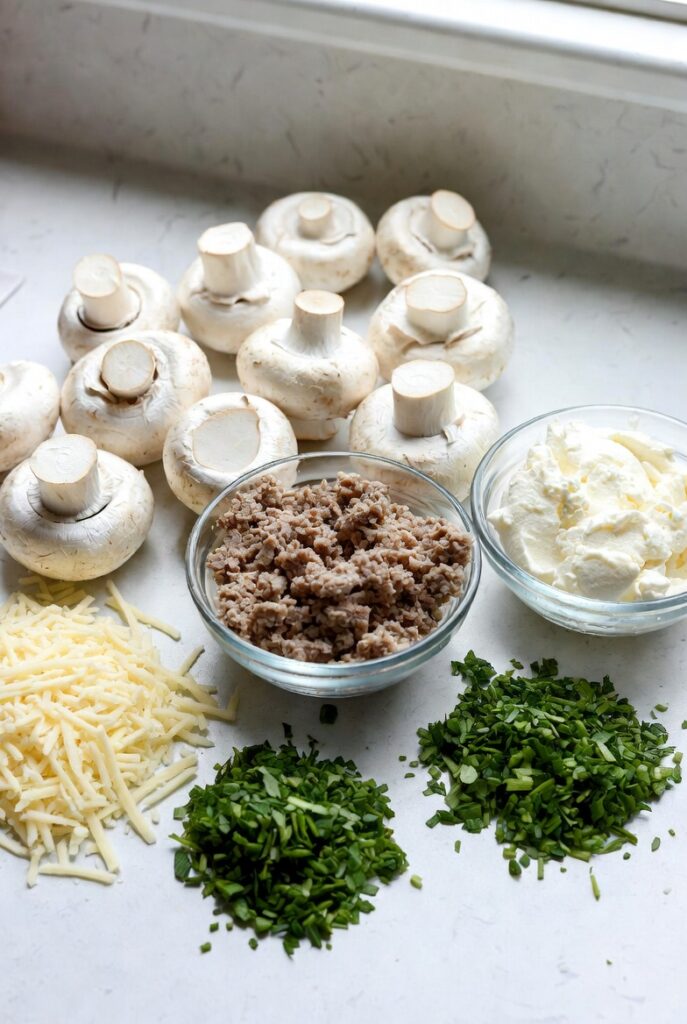
In a dish defined by a minimalist profile, the “Wall Thickness” of the fungi and the “Fat-to-Lean Ratio” of the protein determine the final “Sensory Resolution.”
The Fungal Anchor
- Cremini (Baby Bella) Mushrooms: 24–30 large units.
- The Logic: Select Cremini over White Button mushrooms. Cremini are more mature, possessing a lower water content and a more robust “Earthy Baseline” that can withstand the aggressive spice of the sausage.
The Protein Driver
- Italian Pork Sausage: 1/2 lb (8 oz).
- The Logic: Use “Hot” Italian Sausage for a “Capsaicin High-Note,” or “Sweet” for a more “Herb-Forward” profile. The fennel seeds in Italian sausage provide an “Anise-like” complexity that cuts through the richness of the cream cheese.
The Lipid Matrix (The Filling)
- Cream Cheese: 8 oz, softened. (The “Neutralizing Anchor”).
- Parmigiano-Reggiano: 1/2 cup, finely grated. (For “Saline-Umami” depth).
- Garlic: 3 cloves, microplaned. (The “Allicin Base”).
- Worcestershire Sauce: 1 tsp. (The “Fermented-Umami” clarifier).
The Vibrant Finish
- Fresh Chives: 2 tbsp, minced. (For “Chlorophyll Brightness”).
- Smoked Paprika: A dusting for “Visual Gradient” and a hint of wood-smoke aroma.
6. The “Precision-Coring” Protocol
The most common failure in mushroom assembly is “Shallow Filling.” To achieve a professional-grade result, one must utilize the “Precision-Coring Protocol.”
- The Manual Stem Extraction: Remove the stem by gently “Rocking” it until it snaps at the base. Do not discard; these can be minced and sautéed for other uses.
- The Gill Excavation: Use a melon baller or spoon to scrape out the dark brown gills.
- The Result: By removing the gills, you create a deeper “Well” for the filling and remove the part of the mushroom that holds the most “Aqueous Bitterness.” This ensures a “High-Volume” filling-to-fungi ratio.
7. Deep Dive: The Maillard-Emulsion Synergy
Why is the “Pre-Sear” of the sausage critical? It centers on “Flavor Compounding.” If you place raw sausage inside a mushroom, the meat will “Steam” rather than “Sear.”
By browning the sausage in a skillet first, you trigger the Maillard Reaction, creating “Complex Carbonized Sugars” and “Nutty Aromatics.” When this rendered sausage is folded into the cold cream cheese, the fats “Emulsify.” As they bake, the cream cheese “Insulates” the sausage, keeping it moist, while the sausage “Infuses” the cheese with its rendered fats. This is “Thermodynamic Synergy” at its most efficient.
8. Step-by-Step Instructions: The Master Execution
Step 1: The Aromatic-Protein Reduction
In your skillet over medium-high heat, brown the sausage. Use a spatula to “Aggressively Crumble” the meat into “Micro-Units.” When the sausage is 80% cooked, add the minced garlic and cook for 60 seconds until “Fragrant.”
Step 2: The Lipid-Integration Phase
In a large bowl, combine the softened cream cheese, Parmesan, Worcestershire sauce, and the cooked sausage (including the rendered fats!). Stir until “Homogenous.” This is your “Flavor Anchor.”
Step 3: The Fungal-Prep Protocol
Clean the mushrooms with a “Dry Cloth” (never soak them!). Remove the stems and excavate the gills using the Coring Protocol mentioned in Section 6.
Step 4: The High-Density Loading
Using a teaspoon, mound the filling into each mushroom cap. Press down firmly to ensure “Zero-Air Gaps,” then create a small “Dome” on top. The dome provides more surface area for browning.
Step 5: The Thermal-Radiant Bake
Preheat your oven to 200°C (400°F). Place the mushrooms on the baking sheet (on a wire rack if possible).
Step 6: The Pyrolytic Finish
Bake for 20 minutes.
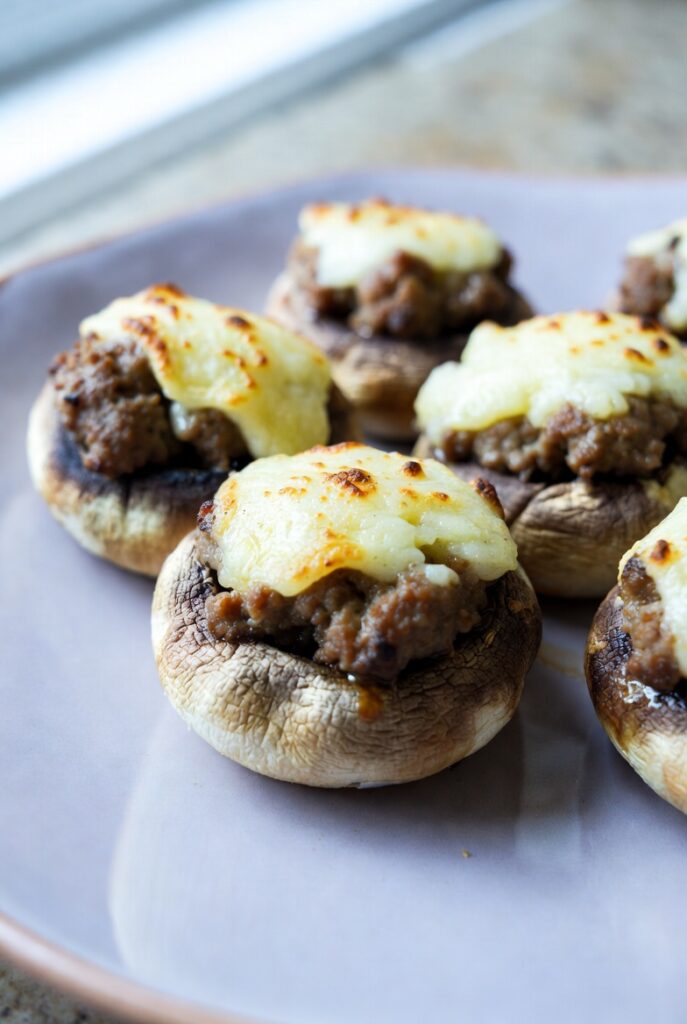
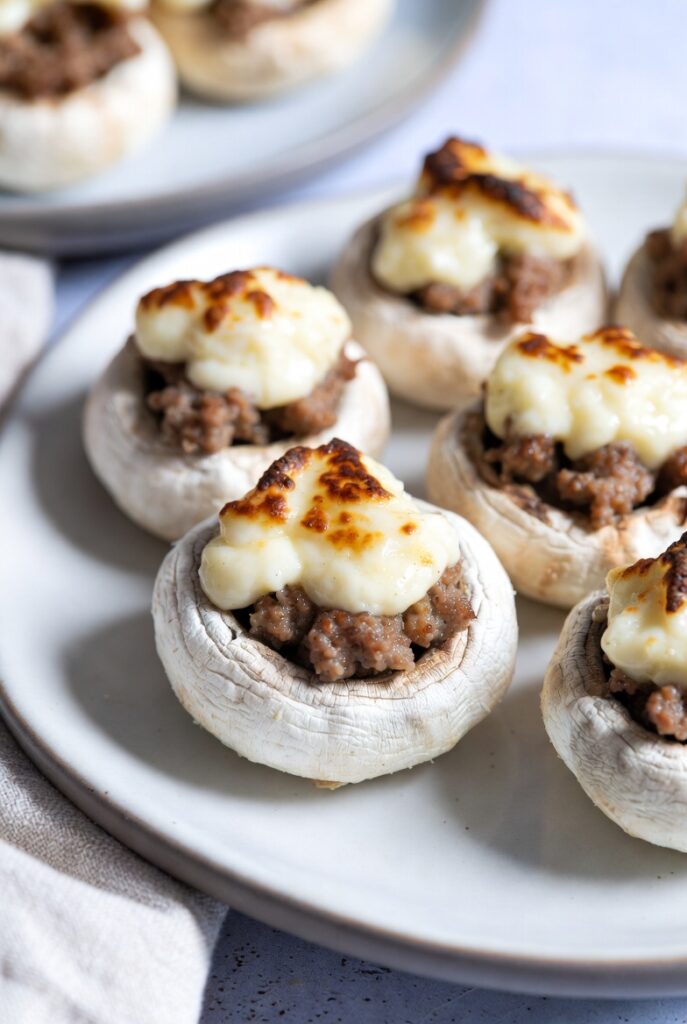
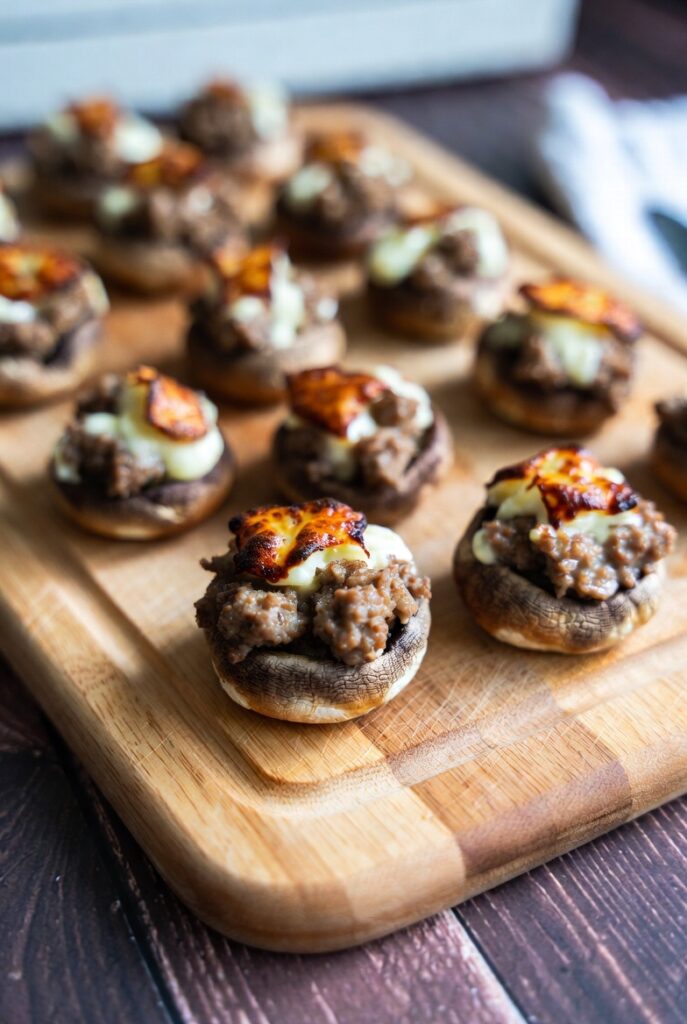
- The Observation: You are looking for the mushroom to appear “Dark and Glistening” and the cheese “Dome” to show “Golden-Amber” spotting (pyrolysis of the milk sugars).
Step 7: The Aromatic Polish
Remove from the oven and garnish immediately with fresh chives and a dusting of paprika. The residual heat will “Bloom” the onion oils without wilting the greens into a dull brown.
9. Satiety and the Fungal-Protein Energy Curve
Stuffed mushrooms provide a unique form of “High-Resolution Satiety.”
- The Glutamate Spike: Mushrooms are naturally rich in Glutamates, the chemical trigger for “Umami.” This signals to the brain that “Protein-Dense” food is being consumed.
- The Lipid-Buffer: The high fat content of the sausage and cheese slows gastric emptying, resulting in a “Flattened Energy Curve” and a prolonged sense of fullness.
- The Chitin Fiber: The cell walls of mushrooms are made of Chitin, a sturdy fiber that provides “Physical Bulk” in the digestive tract.
This makes them the ultimate “High-Performance” appetizer—delivering maximum satiety with a minimal “Carbohydrate Footprint.”
10. Modular Customization: The Flavor Pivots
- The “Coastal” Draft: Replace sausage with Lump Crab Meat and add a dash of Old Bay seasoning.
- The “Mediterranean” Shift: Use Lamb Sausage (Merguez), feta cheese, and chopped kalamata olives.
- The “Plant-Based” Standard: Use “Vegan Sausage Crumble” and a “Cashew-Cream” base. Increase the garlic and add a drop of Liquid Smoke to mimic the porcine depth.
11. Storage and Texture-Recovery
- Refrigeration: Store in an airtight container for up to 3 days.
- The Aqueous Reality: In the fridge, the mushroom will continue to release water. You may notice a small amount of “Dark Liquid” in the container—this is normal.
- The Recovery Method: Never use a microwave. A microwave will turn the mushroom into a “Rubbery Membrane.” Reheat in an air fryer or oven at 190°C (375°F) for 6 minutes. This “Re-Dehydrates” the mushroom and restores the “Creamy-Crisp” contrast.
12. Frequently Asked Questions (FAQ)
Q: My mushrooms are sitting in a pool of water. Why?
A: You likely washed the mushrooms in water (which they absorbed) or the oven temperature was too low. High heat (200°C) is necessary to evaporate the mushroom’s moisture as it is released.
Q: Can I make these in advance?
A: Affirmative. You can stuff the mushrooms up to 24 hours in advance. Keep them refrigerated and bake them “Off-the-Chill.” You may need to add 3 minutes to the total baking time.
Q: Why did the filling pull away from the mushroom?
A: This is “Shrinkage Bias.” As the mushroom loses water, it shrinks. To prevent this, ensure the filling is “Over-Mounded” and pressed firmly into the sides of the cap during assembly.
13. The Chemistry of Flavor: Why This Works
The reason this specific combination is so addictive lies in the “Flavor Network Theory.” Ingredients that share flavor compounds or offer contrasting physical states (soft vs. firm) create higher palatability.
- Pork + Mushroom: Both contain high levels of nucleotides that work synergistically with the glutamates in the cheese to create an “Umami Explosion.”
- Lactic Acid + Fats: The slight tang of the cream cheese provides a “Counter-Acid” to the heavy fats of the sausage, preventing “Palate Fatigue.”
14. Nutritional Information
(Per serving – 4 large mushrooms)
| Nutrient | Amount |
| Calories | 310 kcal |
| Protein | 14g |
| Total Fat | 26g |
| Net Carbs | 5g |
| Vitamin D | 15% DV |
15. The “Visual Gravity” of Presentation
In the 2026 culinary landscape, presentation is as much a part of the “Draft” as flavor.
- The Platter: Use a dark, slate board to contrast the golden domes of the mushrooms.
- The Negative Space: Do not crowd the mushrooms. Leaving 1 inch of space between each unit allows the viewer to appreciate the “Glistening Dermal Integrity” of the fungal caps.
- The Garnish Height: Mince the chives as finely as possible (the “Nano-Mince”) and sprinkle from a height of 12 inches to ensure an even, artistic distribution.
16. Conclusion: The Master Draft of Sensory Equilibrium
The Architecture of Umami is more than a recipe; it is a “Vessel for Intentional Sensation.” It proves that “Gourmet Results” can be achieved through the mastery of “Moisture Management” and “Lipid-Emulsion Stability.” By respecting the “Precision Coring Protocol” and the “Thermal-Radiant Bake,” you are delivering a dish that is visually “Jade-and-Gold,” nutritionally dense, and sensorially perfect.
It is the ultimate “Social Anchor”—a “Molten-Umami” testament to the power of fungi and fire.