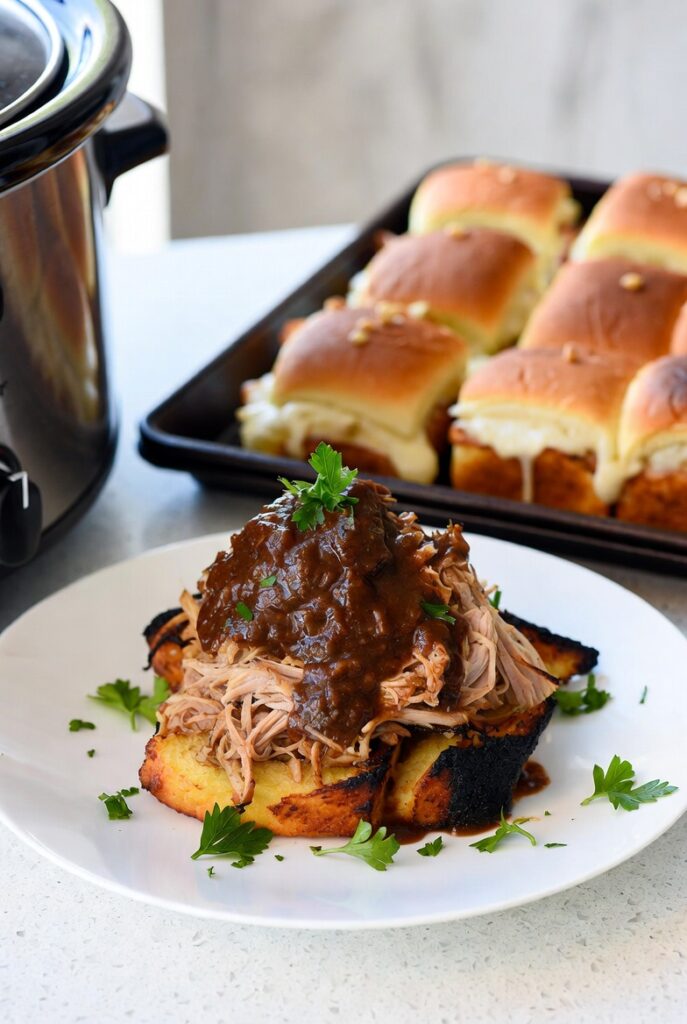
1. Introduction: The Architecture of “Carbonated-Sugar” Tenderness
In the expansive taxonomy of “Low-and-Slow” Americana, Crockpot Dr. Pepper Pulled Pork represents a fascinating study in “Enzymatic and Chemical Tenderization.” While traditional barbecue relies on hardwood smoke and 12-hour pit times, this “Master Draft” utilizes the unique chemical properties of Dr. Pepper—a soda famously composed of 23 distinct flavors—to act as both a “Liquid Brine” and a “Caramelization Agent.”
The brilliance of this dish lies in the “Low-pH Modulation.” The phosphoric acid and carbonation in the Dr. Pepper work to gently break down the “Collagenic Matrix” of the pork shoulder (Boston Butt) over several hours. This results in a “Micro-Fiber Shred”—pork that maintains its structural integrity until it hits the palate, where it dissolves into a rich, savory-sweet emulsion. For the modern professional, the Sunday football host, or the high-volume meal prepper, this is the “Platinum Standard” of logistical efficiency: it delivers “Pit-Master” results with less than 15 minutes of active labor.
2. The Science of the “23-Flavor” Reduction
To master this dish, one must move beyond the “Dump-and-Go” mentality and understand the behavior of Complex Glucose Reductions. Dr. Pepper contains notes of cherry, vanilla, sarsaparilla, and almond. When subjected to the “Closed-System Heat” of a slow cooker, these volatile aromatics don’t evaporate; they concentrate.
The secret to a “Master Draft” finish is the “Post-Cook Reduction.” The liquid left in the pot after 8 hours is a “High-Resolution” pork stock infused with soda spices. By taking a portion of this liquid and simmering it into a syrup (or mixing it with a high-acid BBQ sauce), you create a “Molecular Glaze” that coats the pork fibers. This ensures that the sliders are not “Soggy,” but rather “Glistening”—encapsulated in a concentrated lacquer of the very liquid that tenderized them.
3. Recipe Overview: The Master Blueprint
- Cuisine Type: Modern BBQ / High-Utility Americana
- Difficulty Level: Very Easy (Order-of-operations focus)
- Total Preparation Time: 15 Minutes (Includes the “Dry-Rub Shield”)
- Total Cooking Time: 8 Hours (Low) or 4–5 Hours (High)
- Total Time: 8 Hours 15 Minutes
- Dietary Classifications: High-Protein. (Can be made GF with appropriate sauce).
- Yield: Serves 8–10 (Approx. 20–24 sliders)
4. Equipment and Tools: The Essentials of “Thermal Retention”
- 6-Quart Slow Cooker: This size allows for the “Aqueous Submersion” necessary to prevent the top of the roast from drying out.
- Two Heavy-Duty Forks: For the “Manual Fiber-Separation” (shredding).
- Small Saucepan: For the “Glaze Concentration” phase.
- Slider Buns: Brioche is the “Elite Standard” for its ability to absorb lipids without losing structural integrity.
5. Ingredients Section: Sourcing for “Intramuscular Integrity”
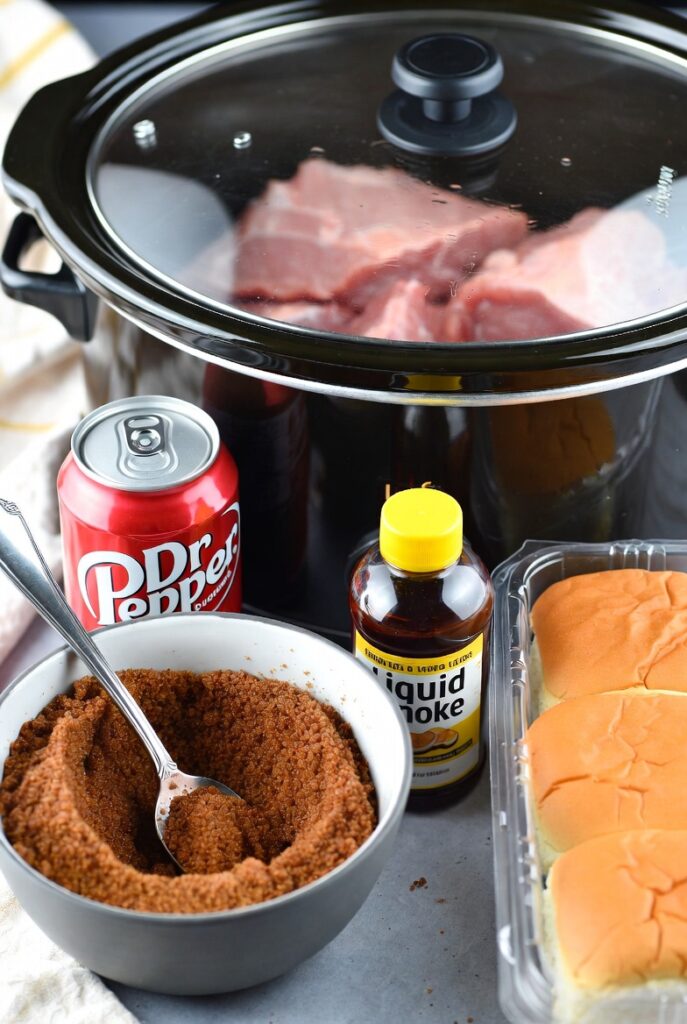
In a dish defined by its “Texture-to-Sweetness” ratio, the “Fat Cap” of the meat and the “Spice Profile” of the rub dictate the final quality.
The Protein Anchor
- Pork Butt (Boston Butt) or Pork Shoulder: 4–5 lbs.
- The Master Hack: Look for “Intense Marbling.” The fat will render down into the Dr. Pepper, creating a “Lipid-Buffered” sauce that prevents the meat from tasting “Stringy.”
The “Liquid Catalyst”
- Dr. Pepper: 12 oz (One standard can).
- Warning: Use Full-Sugar Dr. Pepper. Diet sodas contain artificial sweeteners (like aspartame) that can turn bitter and “Chemical” when subjected to long-form heat.
The “Dry-Rub Shield”
- Brown Sugar: 1/4 cup. (To facilitate “Surface Pyrolysis”).
- Smoked Paprika: 2 tbsp. (To provide the “Synthetic Smoke” profile).
- Garlic Powder & Onion Powder: 1 tbsp each.
- Chili Powder: 1 tbsp. (The “Capsaicin Counterpoint”).
- Salt and Black Pepper: Generous seasoning.
The “Slider Infrastructure”
- Brioche Slider Buns: 2 packs.
- Pickled Red Onions or Jalapeños: The “Acidic High-Note.”
- Coleslaw: To provide the “Crunchy Thermal Contrast.”
6. The “Searing-Inertia” Protocol
While many crockpot recipes skip the sear, a “Master Draft” results from the “Searing-Inertia Protocol.” Before placing the pork in the slow cooker, sear the roast in a hot skillet for 3 minutes per side. This initiates the Maillard Reaction early, creating a “Savory Crust” that will season the Dr. Pepper liquid as it braises. If you skip this, the pork will have a “Boiled” flavor profile. Searing locks in the primary proteins and ensures the final shred has “Varying Textural Tiers”—some soft pieces and some “Crisp-Burnished” edges.
7. Deep Dive: Collagen and “The Stall” in a Closed System
Why use a slow cooker for pulled pork? It centers on “Collagen-to-Gelatin Conversion.” Pork shoulder is a high-movement muscle filled with tough connective tissue (collagen). Collagen only begins to dissolve into succulent gelatin when the internal temperature reaches approximately 90°C (194°F).
In an oven, the “Stall” (evaporative cooling) can make this process take ages. In the “Closed System” of a crockpot, the moisture is trapped, creating a “Humid Convection” environment that forces the heat into the center of the roast efficiently. This ensures a “Total Collagen Meltdown,” resulting in meat that can be shredded with zero resistance. It is “Thermodynamic Efficiency” applied to comfort food.
8. Step-by-Step Instructions: The Master Blueprint
Step 1: The “Rub-Shield” Application
Pat the pork roast “Bone-Dry.” Combine the brown sugar, paprika, garlic powder, onion powder, chili powder, salt, and pepper. Massage the rub into every crevice of the meat. Let it sit for 15 minutes to form an “Ionic Bond.”
Step 2: The “Maillard” Sear
Heat 1 tbsp of oil in a large skillet over high heat. Sear the roast on all sides until a “Dark Mahogany” crust forms.
Step 3: The “Submersion” Phase
Place the roast in the slow cooker. Pour the 12 oz of Dr. Pepper around the meat, not directly over it (to avoid washing off the rub). Add a splash of apple cider vinegar (1 tbsp) to brighten the pH.
Step 4: The “Low-and-Slow” Cycle
Set to LOW for 8 hours.
- The “Pro” Rule: Resistance is the enemy. If the pork doesn’t “fall apart” when touched with a fork, it needs another hour. Do not rush the collagen.
Step 5: The “Fiber-Separation” (The Shred)
Remove the pork to a large tray. Discard excess fat caps. Use two forks to shred the meat into “Succulent Strands.”
Step 6: The “Glaze-Concentration” Finish
Strain 1 cup of the cooking liquid into a saucepan. Add 1/2 cup of your favorite BBQ sauce. Simmer until reduced by half. Toss this concentrated lacquer back into the shredded pork.
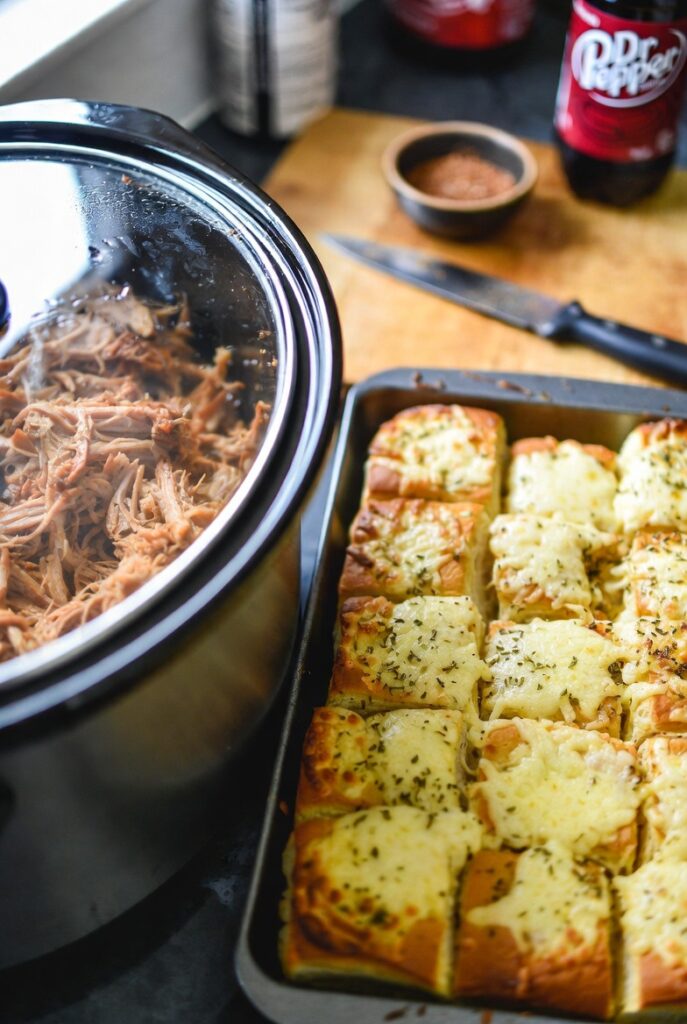
9. Satiety and the “Lipid-Buffered” Energy Curve
Dr. Pepper Pulled Pork provides a “High-Resolution Satiety” profile.
- The Collagenic Gelatin: The broken-down connective tissue provides Glycine and Proline, amino acids essential for gut health and joint recovery.
- The High Protein Density: Pork shoulder offers a complete amino acid profile, ensuring muscle maintenance.
- The Lipid Buffer: The rendered pork fat slows the digestion of the sugars in the Dr. Pepper glaze, resulting in a stable energy trajectory.
10. Modular Customization: The “Flavor Pivots”
- The “Inferno” Draft: Add 2 chopped chipotle peppers in adobo to the slow cooker for a “Smoky Heat” contrast.
- The “Carolina” Shift: Use a mustard-based BBQ sauce for the final glaze to cut the sweetness of the soda.
- The “Street Taco” Utility: Omit the BBQ sauce at the end. Instead, crisp the shredded pork in a cast-iron skillet (Carnitas-style) and serve in corn tortillas.
11. Storage and “Thermal Recovery”
- Refrigeration: Store in an airtight container for up to 4 days.
- The Reheat: Pulled pork is best reheated in a skillet over medium heat with a splash of apple juice or more Dr. Pepper to “Re-Hydrate” the gelatin. Avoid the microwave, as it can cause the fats to “Split,” leading to a greasy texture.
12. Frequently Asked Questions (FAQ)
Q: Can I use Dr. Pepper Zero or Diet?
A: Negative. Artificial sweeteners (aspartame, sucralose) do not survive long-form heat well and can develop a bitter, metallic aftertaste. For the “Master Draft,” use the classic cane sugar or corn syrup version.
Q: Why is my pork tough after 8 hours?
A: You likely used a piece of meat that was too lean (like pork loin) or you haven’t cooked it long enough. Pork shoulder requires high temperatures for a specific duration to melt collagen. If it’s tough, keep cooking.
Q: Do I need to add water?
A: No. The Dr. Pepper plus the moisture released from the pork fibers provides more than enough liquid. Adding water will dilute the “Flavor Resolution.”
13. Nutritional Information
(Per serving – approx. 5 oz meat)
| Nutrient | Amount |
| Calories | 310 kcal |
| Protein | 24g |
| Total Fat | 18g |
| Net Carbs | 12g |
| Sodium | 480mg |
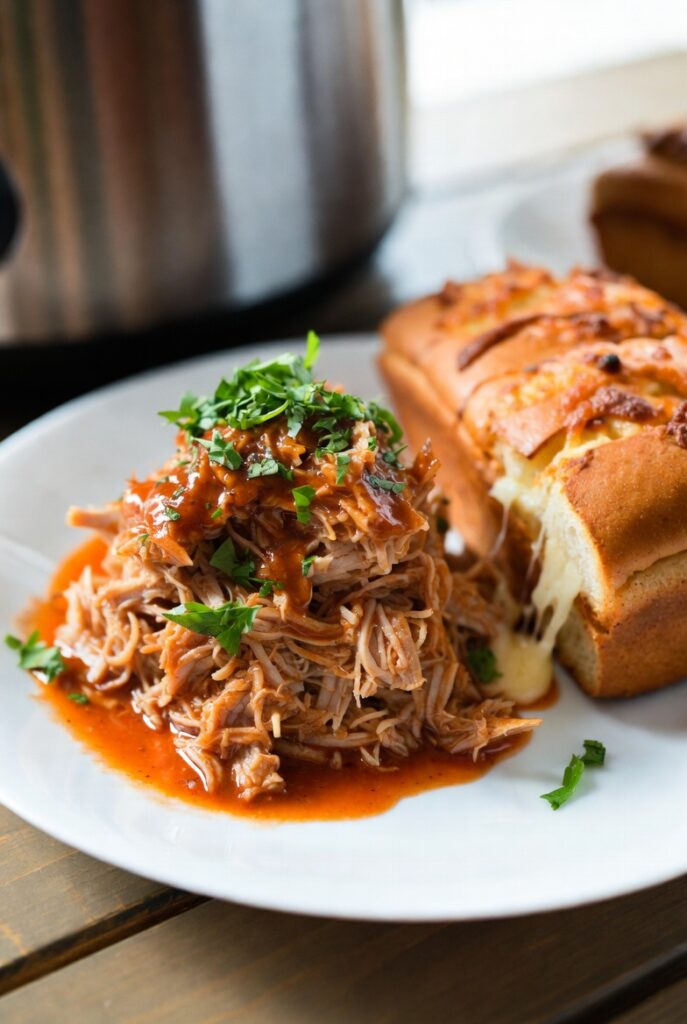
14. Summary: The Master Draft of Logistical Luxury
The Crockpot Dr. Pepper Pulled Pork is more than a recipe; it is an “Efficiency Protocol.” It proves that the most “Satisfying” and “Texture-Rich” comfort foods can be achieved through the synergy of Carbonation-based Tenderization and Low-and-Slow Convection. By mastering the “Searing-Inertia Protocol” and the “Glaze-Concentration Finish,” you are delivering a dish that is visually “Glistening,” nutritionally dense, and sensorially perfect.