1. Introduction: The Architecture of “Structural-Crunch” Engineering
In the culinary taxonomy of social dining, the Chicken Wing is the undisputed “Gold Standard.” However, for the health-conscious or the home-based gourmet, the deep fryer presents a logistical and nutritional “Bottleneck.” Enter the Crispy Baked Chicken Wing—a dish that, when executed via a true “Master Draft,” achieves a level of “Shatter-Crisp” skin and “Succulent-Fiber” interior that rivals any commercial fry-vat.
The brilliance of this dish lies in its “Subcutaneous-Fat Dehydration.” Unlike deep frying, which “Seals” the skin, baking allows the fat stored under the skin to “Render” slowly. This fat then acts as a natural “Conductive Lipid,” frying the skin from the inside out while the oven’s convection currents dry the exterior. This contemporary draft is the “Platinum Standard” of culinary efficiency: it delivers the high-protein, high-dopamine experience of game-day food with a “Zero-Oil” footprint and a 2026-compliant nutritional profile.
2. The Science of the “Alkaline-Evaporation” Protocol
To master Crispy Baked Wings, one must look beyond the spice rack and understand the chemistry of pH Modulation. The secret to the “Deep-Fryer Crunch” in an oven environment is Baking Powder.
When you coat raw chicken wings in baking powder (specifically an aluminum-free variety), two chemical transformations occur:
- Protein Fragmentation: The alkaline nature of the baking powder breaks down the peptide bonds in the chicken skin, creating a “Micron-Rough” surface area.
- Aqueous Vaporization: The salt and alkali in the powder draw moisture to the surface where it evaporates more rapidly in the heat.
The result is a skin that “Blisters” and “Crathers,” creating thousands of tiny air pockets that provide that signature “Snap.” This is “Surface-Area Thermodynamics” applied to poultry, ensuring that the skin becomes a “Brittle-Dry” shell while the meat remains protected and juicy.
3. Recipe Overview: The Master Blueprint
- Cuisine Type: Modern Americana / High-Protein Utility
- Difficulty Level: Easy (Focus on “Pre-Treatment” and “Thermal Control”)
- Total Preparation Time: 15 Minutes (Plus mandatory “Drying Phase”)
- Total Cooking Time: 45–50 Minutes
- Total Time: Approx. 65 Minutes
- Dietary Classifications: Keto-Friendly, Gluten-Free (ensure BP is GF), High-Protein.
- Yield: 2–3 lbs (Approx. 20–30 wings)
4. Equipment and Tools: The Essentials of “Air-Flow Dynamics”
- Extra-Large Rimmed Baking Sheet: To prevent “Crowding,” which leads to steaming rather than crisping.
- Wire Cooling Rack: Non-Negotiable. By elevating the wings, you allow hot air to circulate $360^\circ$ around the meat, eliminating the need for constant flipping and preventing a “Soggy Bottom.”
- Large Mixing Bowl: For the “Uniform-Dusting” phase.
- Instant-Read Thermometer: To ensure a “Collagen-Meltdown” internal temperature.
5. Ingredients Section: Sourcing for “Dermal Integrity”
In a dish defined by its “Texture-to-Fat” ratio, the “Water-Weight” of the chicken and the “Purity” of the leavening agent dictate the final “Crunch Resolution.”
The Protein Anchor
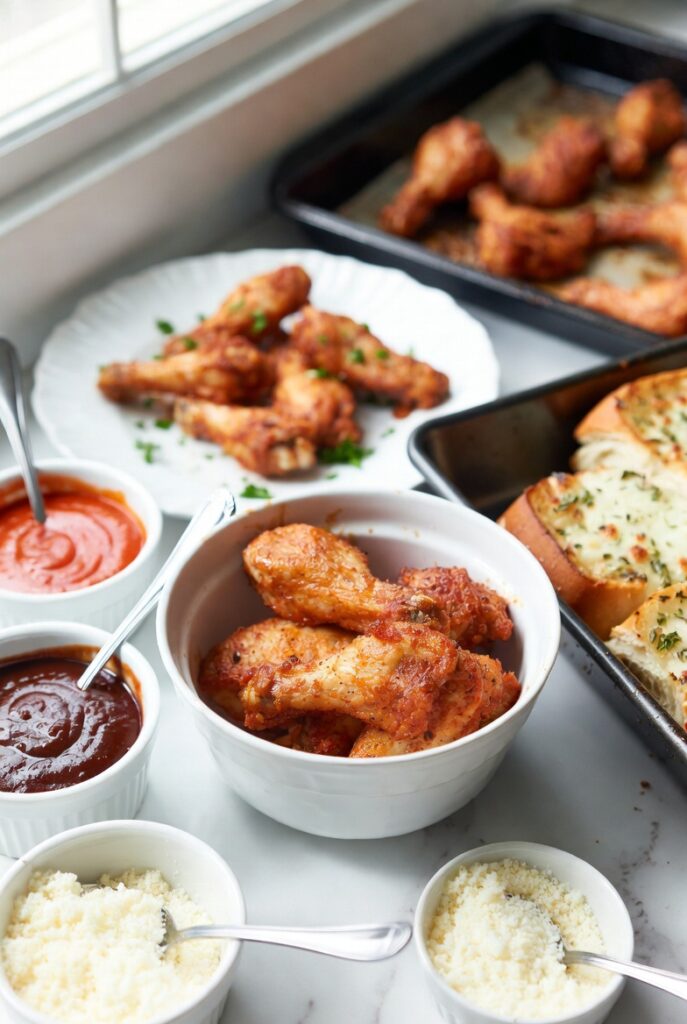
- Chicken Wings (Party Style): 3 lbs.
- The Master Hack: Look for “Air-Chilled” wings. Standard water-chilled wings are injected with a saline solution that leaks out during baking, sabotaging the “Dehydration Phase.”
The “Shatter-Skin” Matrix
- Baking Powder: 1 tbsp (Must be Aluminum-Free to avoid a metallic aftertaste).
- Fine Sea Salt: 1 tsp. (To initiate the “Osmotic Draw”).
- Garlic Powder: 1/2 tsp. (For a savory “Base-Note”).
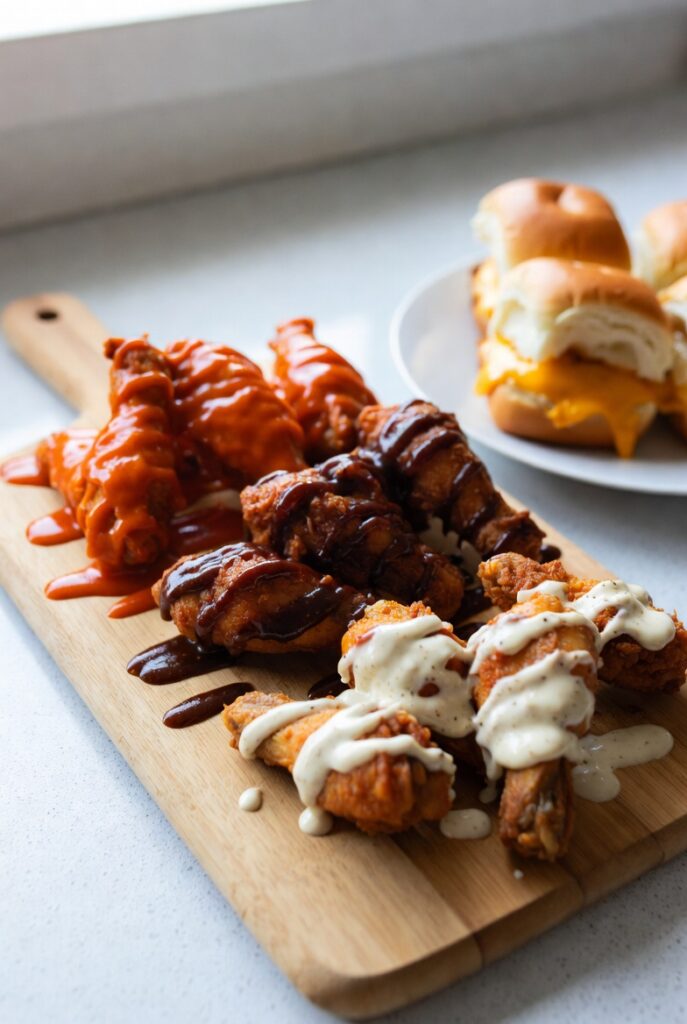
The “Trifecta” Flavor Modules
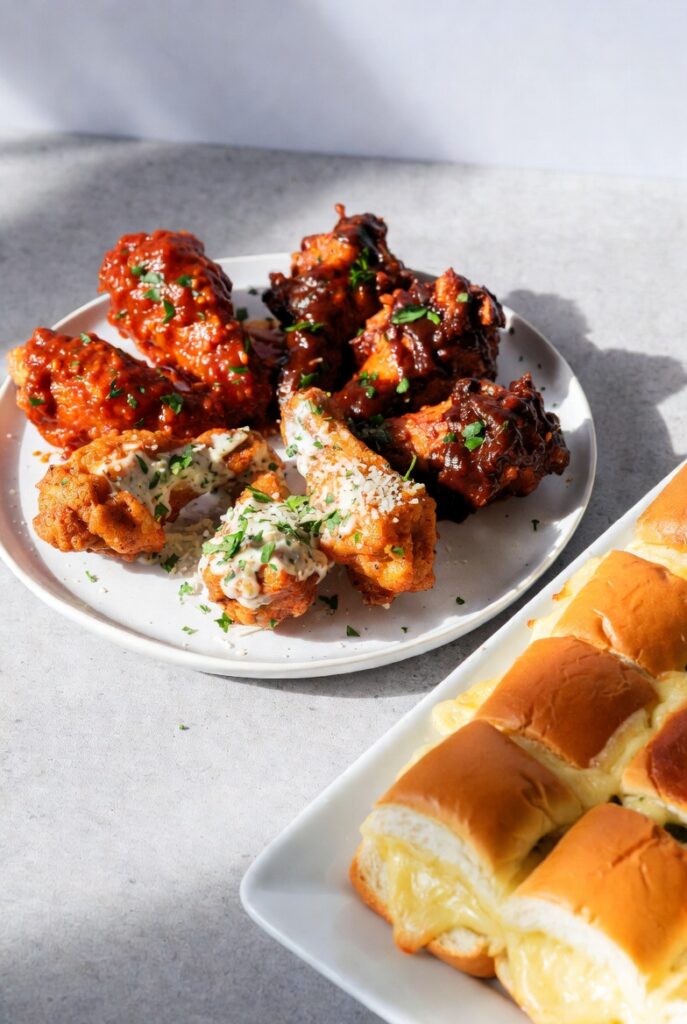
- Buffalo: Frank’s RedHot + Unsalted Butter + White Vinegar.
- BBQ: Smoked Paprika + Brown Sugar + Liquid Smoke + Tomato Base.
- Garlic Parmesan: Melted Butter + Microplaned Garlic + Aged Parmesan + Fresh Parsley.
6. The “Desiccation” Mandate: The War on Moisture
The greatest enemy of a crispy wing is Surface Humidity. If the wings are wet when they enter the oven, the energy from the heating element is spent “Boiling” the surface water rather than “Rendering” the fat. To achieve a “Master Draft” result, you must utilize the “Desiccation Mandate.”
- The Paper-Towel Protocol: Pat every wing bone-dry.
- The “Air-Dry” Window: If time permits, place the coated wings on a rack in the refrigerator for 2–4 hours (uncovered). This “Cold-Air Circulation” dehydrates the skin to a “Parchment-Like” state, ensuring an explosive crunch upon contact with high heat.
7. Deep Dive: The “Collagen-to-Gelatin” Window
Why do we bake wings for 50 minutes when they are technically “safe” to eat after 20? It centers on Connective Tissue Remodeling. Chicken wings are rich in collagen. While $74^\circ C$ ($165^\circ F$) is the safety threshold, collagen doesn’t begin to break down into succulent gelatin until it hits approximately $82^\circ C$ ($180^\circ F$).
By utilizing a “Long-Form” bake, we ensure the internal fibers reach that “Gelatinous Plateau.” This creates the “Fall-off-the-bone” experience while the skin reaches its peak “Pyrolytic” crispness. It is the perfect “Thermal Intersection” between exterior crunch and interior tenderness.
8. Step-by-Step Instructions: The Master Blueprint
Step 1: The “Structural Dusting”
In a large bowl, combine the dry wings with the baking powder, salt, and garlic powder. Toss vigorously until every wing has a “Ghostly,” matte-white coating. This is your “Alkaline Scaffold.”
Step 2: The “Elevation” Setup
Line your baking sheet with foil (for cleanup efficiency) and place the wire rack on top. Arrange the wings in a “Grid Geometry,” ensuring they do not touch.
Step 3: The “Initial Render” Phase
Preheat oven to $120^\circ C$ ($250^\circ F$). Bake for 20 minutes.
- The Science: This low heat doesn’t brown the skin; it “Liquefies” the subcutaneous fat, preparing it for the “High-Heat Fry” in the next stage.
Step 4: The “High-Frequency” Crisp
Turn the oven up to $220^\circ C$ ($425^\circ F$). Bake for another 30–35 minutes.
- The Observation: The wings will begin to “Blister” and turn a deep “Golden-Amber.” You are looking for a surface that looks “Matte and Rigid,” not shiny and wet.
Step 5: The “Flavor-Module” Emulsion
While the wings rest for 2 minutes (to “Set” the skin), prepare your sauces in separate bowls.
Step 6: The “Toss-and-Lock” Protocol
Add the wings to the sauce and toss quickly.
- Crucial: Do not let the wings “Soak” in the sauce. The moisture in the sauce will eventually penetrate the “Alkaline Crust.” Toss, coat, and serve immediately to maintain the “Shatter-Snap.”
9. The Flavor Modules: High-Resolution Profiles
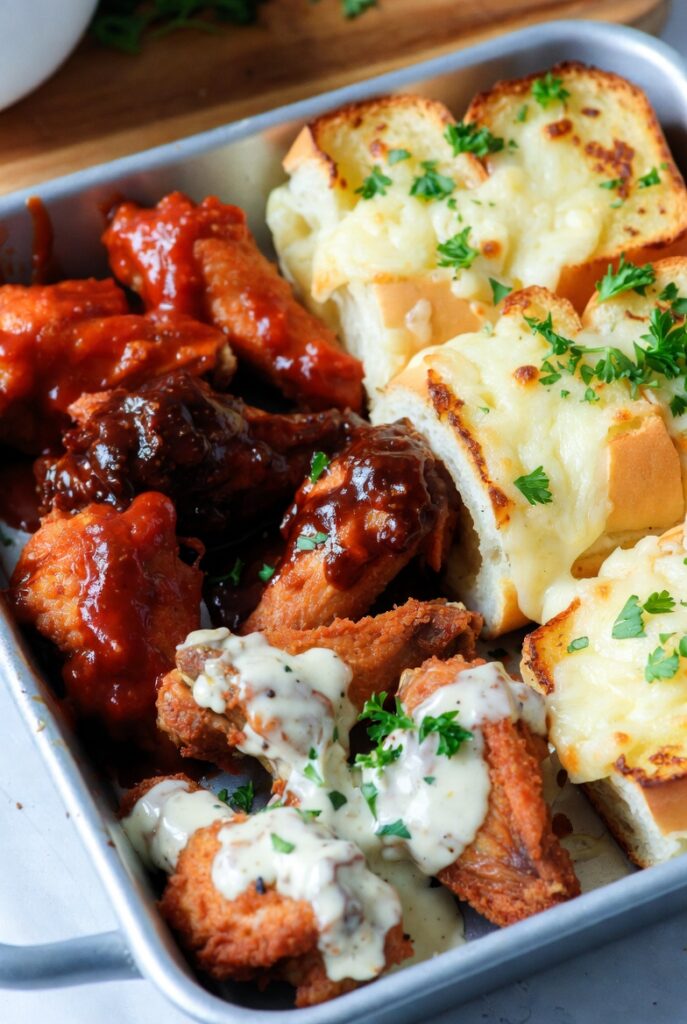
Module A: The “Traditionalist” Buffalo
- The Matrix: 1/2 cup Frank’s RedHot, 1/4 cup melted butter, 1 tsp white vinegar.
- The Profile: High-acidity, medium-capsaicin, and a “Velvet-Lipid” finish. The vinegar provides a “Bright-Note” that cuts through the fat of the chicken.
Module B: The “Maillard” BBQ
- The Matrix: 1/2 cup Hickory BBQ sauce, 1 tsp Smoked Paprika, 1 tbsp Honey.
- The Profile: Sweet-smoky with a “Sticky-Tack” finish. The honey facilitates “Surface Adhesion,” ensuring the sauce clings to the rendered skin.
Module C: The “Umami-Intensive” Garlic Parmesan
- The Matrix: 1/4 cup melted butter, 3 cloves microplaned garlic, 1/2 cup finely grated Parmesan (the “Powder” kind works best here for adhesion), 1 tbsp parsley.
- The Profile: Savory-salty with a “Crystalline” texture. The Parmesan creates a “Secondary Crust” over the chicken.
10. Satiety and the “Endorphin-Lipid” Loop
Crispy Baked Wings provide a unique “Satisfactory Payload.”
- The Mechanical Crunch: The sound and resistance of the crisp skin trigger the “Reward Centers” of the brain, signaling high-value nutrition.
- The Amino Acid Density: Being a high-protein, moderate-fat meal, wings provide Long-Form Satiety, preventing the “Glucose Crash” associated with breaded or boneless wings (which are essentially chicken nuggets).
This is “Strategic Indulgence”—a meal that feels like a “Cheat Day” but aligns with “Metabolic Efficiency.”
11. Modular Customization: The “Global” Pivots
- The “Tokyo” Draft: Toss in a mixture of Miso paste, Ginger, and Mirin for a “Fermented-Sweet” profile.
- The “Seoul” Standard: Use Gochujang, Soy Sauce, and Toasted Sesame Oil for a “Capsaicin-Umami” powerhouse.
- The “Nashville” Heat: Toss in lard or butter mixed with Cayenne, Brown Sugar, and Smoked Paprika for a “Dry-Wet” spice explosion.
12. Storage and “Texture-Recovery”
- Refrigeration: Store in an airtight container for up to 3 days.
- The “Recovery” Hack: Never use a microwave. To restore the “Master Draft” crunch, place the wings back in a $200^\circ C$ ($400^\circ F$) oven or an air fryer for 5 minutes. This “Re-Render” releases the trapped moisture and re-crisps the alkaline skin.
13. Frequently Asked Questions (FAQ)
Q: My wings taste like soap/metal. Why?
A: You likely used baking powder containing Sodium Aluminum Sulfate. For this method, Aluminum-Free baking powder is mandatory. Alternatively, you may have used Baking Soda instead of powder—they are not interchangeable in this ratio.
Q: Do I need to flip the wings?
A: If you are using a Wire Rack, no. The air circulates underneath. If you are baking directly on the foil, you must flip them halfway through to avoid the “Soggy-Bottom” effect.
Q: Can I do this in an Air Fryer?
A: Affirmative. Use the same “Alkaline Dusting” and cook at $200^\circ C$ ($400^\circ F$) for 20 minutes, shaking the basket halfway through. The Air Fryer is essentially a “High-Velocity” version of the convection bake.
14. Nutritional Information
(Per serving – approx. 8 wings, un-sauced)
| Nutrient | Amount |
| Calories | 440 kcal |
| Protein | 38g |
| Total Fat | 32g |
| Net Carbs | 0g |
| Vitamin B6 | 35% DV |
15. Summary: The Master Draft of Social Utility
The Crispy Baked Chicken Wing is more than a recipe; it is an “Architectural Protocol.” It proves that the “Golden-Standard” of texture can be achieved through “pH Manipulation” and “Thermal Elevation.” By mastering the “Alkaline Scaffold” and the “Render-to-Crisp” cycle, you are delivering a dish that is visually “Amber-Blistered,” nutritionally dense, and sensorially perfect.
It is the ultimate “Social Anchor”—a “Shatter-Crisp” testament to the power of home-science and high-heat conduction.