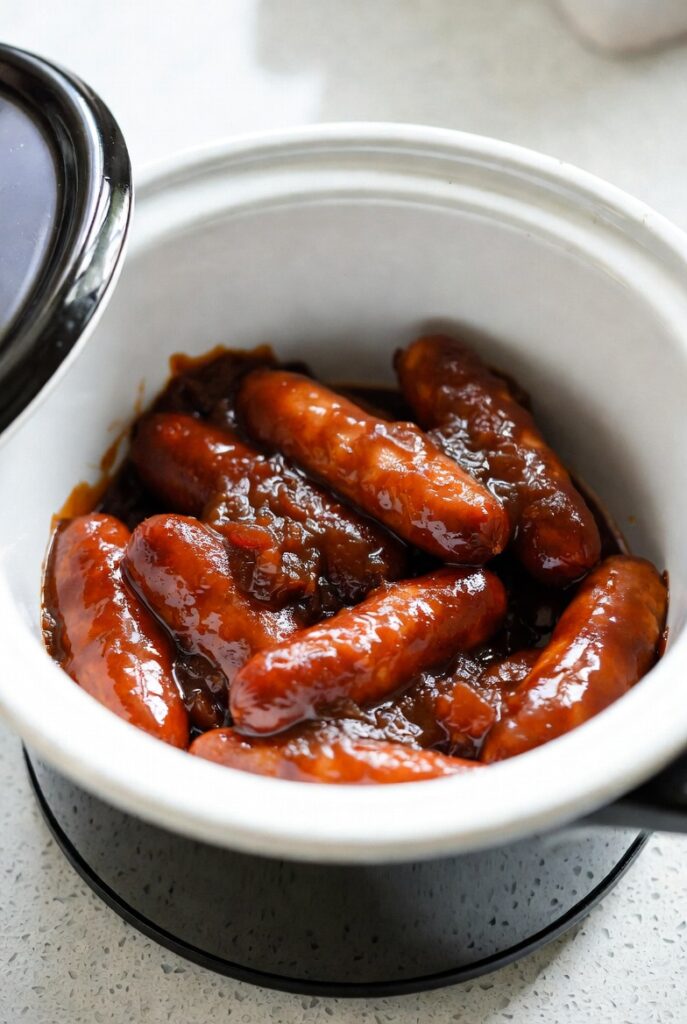
1. Introduction: The Alchemy of the “High-Gloss” Glaze
In the pantheon of social gastronomy and game-day traditions, few dishes represent the “Symphony of Simplicity” quite like Crockpot Little Smokies. While high-brow culinary circles may overlook the humble cocktail sausage, a true “Master Draft” of this dish is a sophisticated study in “Viscosity Management” and “Acid-Sugar Equilibrium.” This is not merely a “dump-and-heat” recipe; it is a quintessential example of American regional fusion. The combination of grape jelly—a high-pectin fruit preserve—and barbecue sauce—a complex, vinegar-based condiment—creates a “Molecular Glaze” that is unparalleled in its ability to adhere to protein. For the modern host, the high-performance professional, or the “Saturday Socialite,” this dish is the “Zero-Friction” MVP. It requires minimal “Cognitive Load” to prepare, offers a high “Satiety Index,” and utilizes low-temperature, long-form conduction to transform basic ingredients into a shimmering, mahogany-hued masterpiece.
2. The Science of the “Pectin-Lipid” Bond
To master Crockpot Little Smokies, one must look past the labels and understand the behavior of Pectin and Capsaicin.
The secret to the “Platinum-Standard” sauce lies in the “Pectin Reduction.” Grape jelly is rich in pectin, a structural heteropolysaccharide contained in the primary cell walls of terrestrial plants. When subjected to the gentle, consistent heat of a slow cooker, the pectin molecules begin to cross-link, transforming the jelly from a semi-solid state into a “High-Gloss Liquid.”
Simultaneously, the “Lipid Infusion” occurs as the cocktail smokies—typically a blend of beef and pork—release a small amount of rendered fat into the sauce. This fat acts as a “Flavor Carrier,” binding the smoky notes of the meat to the fruit sugars of the jelly and the acetic acid (vinegar) of the barbecue sauce. The result is a “Uniform Emulsion” that coats the sausages in a thick, sticky veneer that doesn’t “break” or become watery, even over several hours of service.
3. Recipe Overview: The Master Blueprint
- Cuisine Type: Mid-Century Americana / Tailgate Classic
- Difficulty Level: Beginner (Focus on “Set-and-Forget” logistics)
- Total Preparation Time: 5 Minutes
- Total Cooking Time: 2 to 3 Hours (High) or 4 to 5 Hours (Low)
- Total Time: Variable (Low-maintenance)
- Dietary Classifications: High-Protein, Gluten-Free (verify sauce labels).
- Yield: Serves 10–12 (The “Crowd-Pleaser” Volume)
4. Equipment and Tools: The Essentials of Low-Energy Conduction
The success of this dish relies on “Thermal Stability.”
- 4 to 6-Quart Slow Cooker (Crockpot): The oval-shaped ceramic vessel is ideal for ensuring even heat distribution across the “Sausage Matrix.”
- Silicone Spatula: For the “Initial Integration”—ensuring the jelly is broken down and mixed with the sauce before the heat cycle begins.
- Disposable Slow Cooker Liners (Optional): While not required for flavor, they are the “Peak Efficiency” choice for rapid post-event cleanup.
- Toothpicks or Cocktail Forks: The “Primary Delivery Vehicle” for social consumption.
5. Ingredients Section: Sourcing for the “Umami-Sweet” Loop
In a dish with only three primary components, the “Flavor Profile” of your sauce dictates the entire sensory experience.
The Protein Anchor
- Cocktail Smokies (Little Smokies): 28–32 oz (approx. two standard packs).
- The Choice: Use a “Beef and Pork” blend for the best structural integrity and flavor depth.
The “Glaze” Foundation
- Grape Jelly: 18 oz (one standard jar).
- The Science: Concord grape jelly provides the specific “Pectin Density” required for the glaze to thicken correctly.
- Barbecue Sauce: 18 oz (one standard bottle).
- The Master Hack: Choose a “Hickory” or “Smoky” BBQ sauce. Avoid “Honey” or “Sweet” BBQ sauces, as the grape jelly already provide the necessary glucose. You need the “Vinegar and Smoke” of the sauce to provide the “Acidic Counterpoint.”
The “Master Draft” Enhancers (The Gourmet Pivot)
- Dijon Mustard: 1 tbsp (The “Emulsifying Spike”).
- Sriracha or Cayenne: 1/2 tsp (The “Thermogenic Kick”).
- Apple Cider Vinegar: 1 tsp (If your BBQ sauce lacks “Acidic Brightness”).
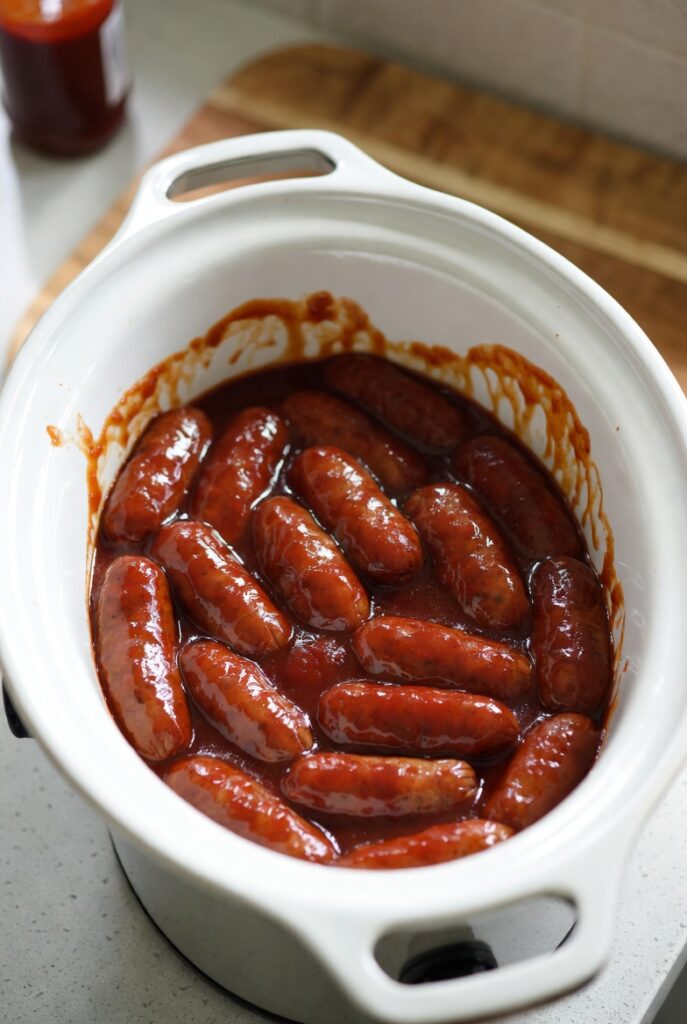
6. The “Cold-Start” Integration Protocol
The most common failure in Little Smokies is “Lumpy Sauce”—where pockets of grape jelly fail to melt, leaving uneven patches of sweetness. To achieve a “Master Draft” finish, you must utilize the “Cold-Start Integration.”
Before turning on the slow cooker, place the jelly and BBQ sauce in the ceramic pot. Use a whisk or spatula to break the jelly into small, uniform pieces. Only after the sauce is a relatively consistent slurry should you add the smokies. As the heating element slowly raises the temperature, the jelly will melt evenly from the inside out, ensuring a “Shatter-Smooth” glaze that looks professional.
7. Deep Dive: Satiety and the “Protein-Sugar” Spike
Why are Little Smokies the ultimate social fuel? It centers on the “Satiety-Energy Balance.” Cocktail sausages are a concentrated source of protein and fats, which trigger the release of cholecystokinin (the “I’m Full” hormone).
However, the sugar in the grape jelly provides an immediate “Glucose Spark.” In a social or game-day setting, this provides a quick burst of energy while the protein and fats provide the “Steady-State” satiation that prevents guests from feeling “Hangry.” From a biological standpoint, it is a “High-Reward” food that stimulates the dopamine centers of the brain through the combination of salt, fat, and sugar—making it the undisputed “MVP” of the appetizer table.
8. Step-by-Step Instructions: The Master Blueprint
Step 1: The “Viscosity Blend”
Place the grape jelly and BBQ sauce into the slow cooker. If you are using the “Enhancers” (Dijon or Sriracha), add them now. Stir until the mixture is combined but still slightly textured.
Step 2: The Protein Submersion
Add the cocktail smokies to the sauce. Use a large spoon to toss the sausages until every single “Smokie” is fully encapsulated in the sauce matrix. This ensures even heat transfer.
Step 3: The Thermal Cycle
Cover the slow cooker with the lid.
- The “Performance” Path: Cook on HIGH for 2 to 3 hours. This is ideal if you are short on time and want the sauce to reduce quickly.
- The “Deep-Infusion” Path: Cook on LOW for 4 to 5 hours. This allows the smoke flavor from the sausages to permeate the sauce more deeply.
Step 4: The “Aeration” Stir
Midway through the cooking process, give the smokies a gentle stir. This redistributes the rendered fats and ensures the sausages at the top don’t dry out.
Step 5: The “Glistening” Finish
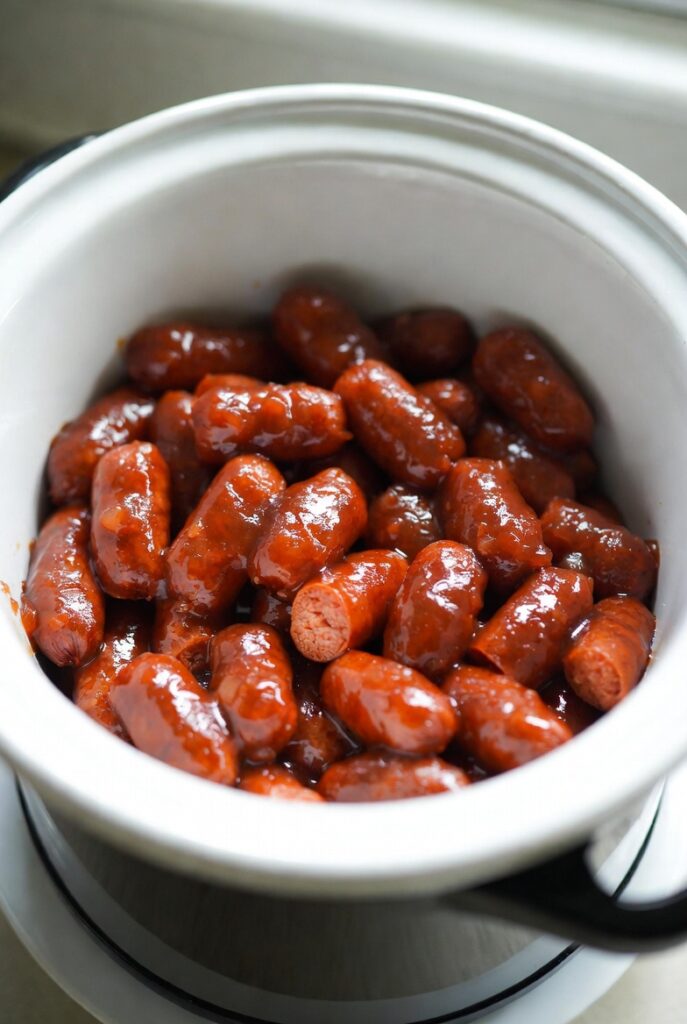
Once the sauce is bubbling and has thickened to a “Maple Syrup” consistency, turn the slow cooker to the “KEEP WARM” setting. Serving them at a consistent $60^\circ C$ to $70^\circ C$ (140°F to 160°F) ensures the glaze remains “Viscous” and doesn’t harden.
9. Modular Customization: The “Regional” Pectoral
While the “Grape & BBQ” duo is the standard, this dish is a “Flexible Template”:
- The “Tropical” Shift: Replace grape jelly with Pineapple Preserves and add a splash of soy sauce for a “Polynesian-American” profile.
- The “Spicy-Sweet” Standard: Replace grape jelly with Chili Sauce (like Heinz) and add a tablespoon of horseradish for a “Zesty Cocktail” finish.
- The “Bourbon” Fortification: Add 2 ounces of Kentucky Bourbon to the sauce during Step 1. The alcohol will cook off, leaving behind a “Deep Caramel” complexity.
- The “Cranberry” Pivot: During the holiday season, swap grape jelly for Whole Berry Cranberry Sauce for a “Tart-Acidic” holiday twist.
10. The “Social Logistics” of the Crockpot
One of the hidden benefits of this dish is its “Thermal Resilience.” Unlike “Flash-Fried” appetizers (like chicken wings or mozzarella sticks) that have a “Quality Half-Life” of about 10 minutes before they become soggy or cold, Little Smokies are “Indestructible.”
They can sit in a slow cooker for 6 hours on the “Warm” setting and actually improve in flavor as the sauce continues to undergo “Micro-Reductions.” This makes them the “Low-Maintenance” choice for hosts who want to engage with their guests rather than being tethered to the oven.
11. Storage and “The Second-Day Glaze”
- Refrigeration: Store in an airtight container for up to 4 days.
- The “Sauce-Set” Phenomenon: In the fridge, the pectin in the sauce will cause it to set into a firm gelatin. This is normal.
- The Reheat: To restore the “Master Draft” shine, reheat in a saucepan on the stove with 2 tablespoons of water. The water will “thin” the set pectin, returning the sauce to its original glistening state. Avoid the microwave if possible, as it can cause the sausages to “split” due to internal steam pressure.
12. Frequently Asked Questions (FAQ)
Q: My sauce is too thin. How do I fix it?
A: Take the lid off the slow cooker and turn it to HIGH for the last 30 minutes. This allows for rapid evaporation and “Pectin Concentration.”
Q: Can I use different types of sausages?
A: Affirmative. You can use sliced kielbasa or bratwurst. However, you lose the “Bite-Sized Utility” of the Little Smokies. If using larger sausages, slice them into 1-inch “rounds” to maintain the “Dip-ability.”
Q: Is the grape jelly flavor “obvious”?
A: No. When combined with the vinegar and spices of the BBQ sauce, the “Grape” identity disappears, leaving only a “Fruit-Dense Sweetness” that tastes remarkably like a high-end gastrique.
13. Nutritional Information
(Per serving – approx. 5 smokies)
| Nutrient | Amount |
| Calories | 290 kcal |
| Protein | 8g |
| Total Fat | 18g |
| Net Carbs | 22g |
| Sodium | 680mg |
14. Summary: The Master Draft of Social Utility
Crockpot Little Smokies are more than a snack; they are a “System of Satisfaction.” They prove that you don’t need a 20-ingredient list to achieve “Flavor Complexity.” By mastering the “Pectin Reduction” and the “Cold-Start Integration,” you are delivering an appetizer that is biologically dense, culturally nostalgic, and industrially efficient.
It is a dish that honors the body’s craving for “Lipid-Sugar” synergy while respecting the host’s need for “Zero-Friction” logistics. It is the ultimate fuel for a high-intensity social gathering, delivered in a “Glistening, Mahogany-Glazed” package.