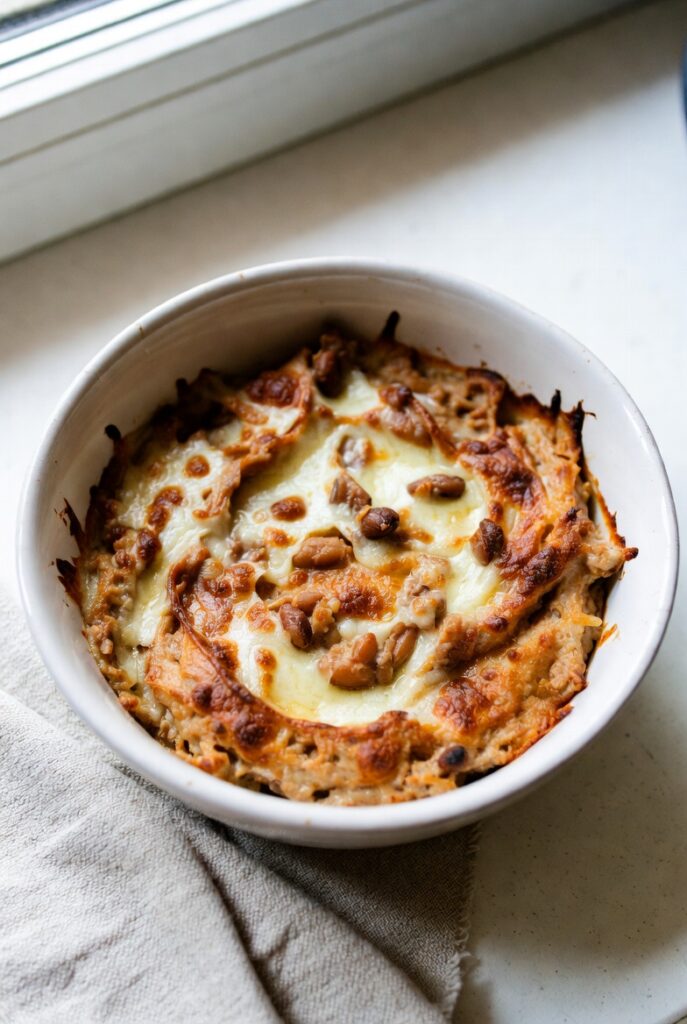
1. Introduction: The Architecture of the “Infinite Scoop”
In the demanding environment of a tailgate, potluck, or high-energy social gathering, the Cheesy Refried Bean Dip stands as the “Structural Foundation” of the appetizer table. While other dips—particularly those based solely on dairy—may break, separate, or lose their thermal integrity rapidly, a bean-based assembly offers unparalleled “Thermal Resilience” and “Viscosity Consistency.” This dish represents a masterful “Bio-Available” appetizer, taking the humble, fiber-rich legume and fortifying it with a high-lipid cheese matrix and piquant aromatics to create a “Signature Assembly.”
The brilliance of this Cheesy Refried Bean Dip lies in its “Frictionless Delivery.” By utilizing the natural starches of the pinto bean, we achieve a texture that provides maximum “Chip-Cling”—the ability of the dip to adhere to a vessel without snapping it under the weight of the scoop. For the modern host, this is the ultimate “High-Utility” appetizer: it is low-cost, high-protein, and can be assembled with minimal mechanical labor. It is a dish that respects the culinary heritage of the American Southwest while utilizing modern “One-Pot” efficiency to deliver a consistent, “Elite-Tier” result that satisfies the most aggressive of appetites.
2. The Science of the “Starch-Lipid Bond”
To master the Cheesy Refried Bean Dip, one must understand the relationship between $amylopectin$ (bean starch) and $dairy lipids$ (cheese and sour cream). Refried beans are essentially a concentrated paste of protein and fiber. On their own, they can be dense, “clay-like,” and psychologically heavy.
The secret to a professional-grade result is the “Emulsification Phase.” By introducing sour cream and softened cream cheese, we are “aerating” the bean matrix. The fats in the dairy surround the starch granules, preventing them from bonding too tightly. This creates a “Silken Flow” that remains scoopable even as the dip cools on the table. This is “Rheological Optimization”—managing the flow and deformation of the food to ensure it stays in the “Goldilocks Zone” between a solid and a liquid.
Furthermore, we utilize a “Dual-Heat” approach with spices. By combining the “Front-End Heat” of fresh jalapeños or green chiles with the “Slow-Burn” of cumin and chili powder, we trigger a wider range of taste receptors. This ensures that the richness of the beans is constantly balanced by a subtle “Aromatic Spark.” This prevents “Palate Fatigue”—the point at which a guest stops eating because the flavor profile has become too one-dimensional and heavy.
3. Recipe Overview: The Master Blueprint
- Cuisine Type: Tex-Mex / Southwest Comfort
- Difficulty Level: Very Easy (Assembly-focused)
- Total Preparation Time: 10 Minutes
- Total Cooking Time: 20 Minutes
- Total Time: 30 Minutes
- Dietary Classifications: Vegetarian, High-Fiber, Gluten-Free.
- Yield: Serves 10 to 12
4. Equipment and Tools: The Essentials of Thermal Retention
The structural success of your Cheesy Refried Bean Dip depends on a vessel that can facilitate even heat distribution and prevent the bottom layer of beans from dehydrating.
- 9×9 inch Ceramic Baking Dish or 10-inch Cast Iron Skillet: Ceramic is the “Thermal Standard” for beans, providing a “Slow-Release” of heat that keeps the dip molten for up to 30 minutes post-oven.
- Large Stainless Steel Mixing Bowl: To ensure the beans are thoroughly integrated with the dairy components before baking.
- Silicone Spatula: Essential for the “Folding Process”—ensuring the cheese is evenly distributed through the density of the beans.
- Box Grater: For shredding your own cheese. Pre-shredded cheese is coated in potato starch, which can interfere with the “Smooth-Melt” objective of this dip.
5. Ingredients Section: Sourcing for Nutrient Density
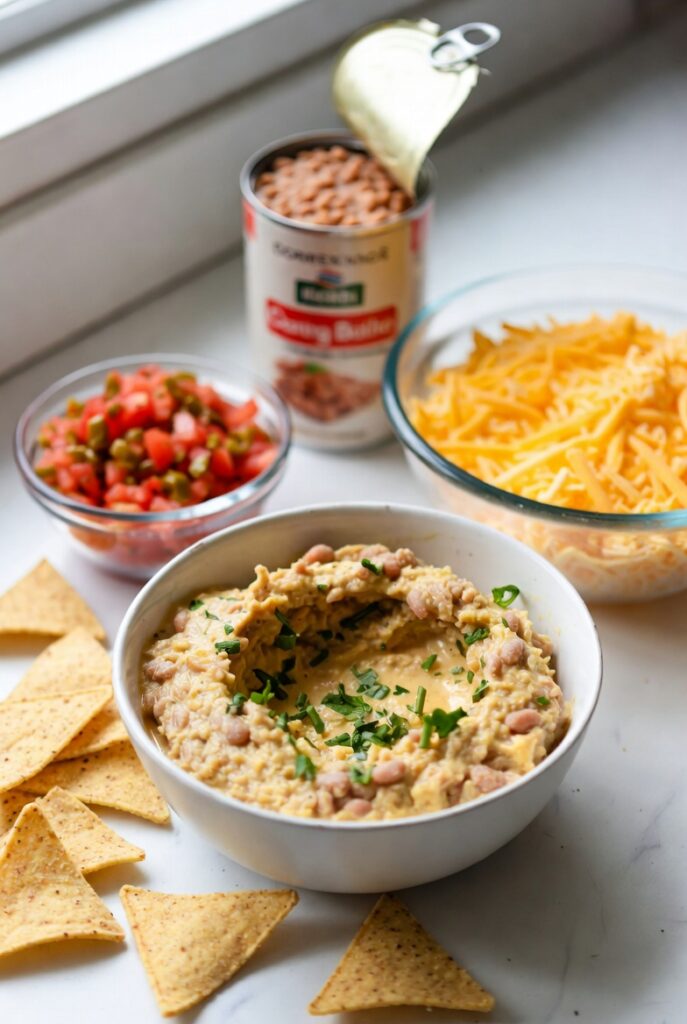
In a dish with a focused flavor profile, the “Molecular Integrity” of the beans and the “Cure” of the spices dictate the final depth.
The Protein & Fiber Anchor
- Refried Beans: 2 cans (15 oz each). For the “Master Draft,” look for beans cooked in traditional styles for maximum flavor.
- Pinto Beans (Whole): 1/2 cup, drained. Adding a small amount of whole beans provides “Textural Contrast,” preventing the dip from feeling like a purée.
The Lipid Matrix
- Cream Cheese: 8 oz, softened. This is the “Structural Insulator.”
- Sour Cream: 1/2 cup. Provides the “Acidic Tang” and moisture.
- Mild or Sharp Cheddar: 1.5 cups, shredded.
- Monterey Jack Cheese: 1 cup, shredded. This provides the “Elastic Stretch.”
The Southwest Engine
- Taco Seasoning or “Albuquerque Blend”: 1.5 tablespoons (Cumin, Chili Powder, Garlic Powder, Onion Powder).
- Diced Green Chiles: 1 small can (4 oz). Provides “Mellow Heat” and moisture.
- Salsa or Hot Sauce: 1/4 cup. To adjust the “Viscosity” and “Spice Level.”
6. The “Layering vs. Folding” Debate
There are two primary schools of thought regarding Cheesy Refried Bean Dip: the “Layered Assembly” (think 7-layer dip) and the “Integrated Fold.” For a hot, baked dip, the “Integrated Fold” is the superior strategy.
By folding the cheeses and dairy into the beans before baking, you create a “Homogeneous Emulsion.” As the dip heats, the cheese melts inside the bean structure, creating pockets of molten fat that lubricate the fiber. This prevents the top of the dip from becoming a “hard cheese shell” while the bottom remains a cold, dry block of beans. When you pull a chip through an integrated dip, you get a balanced ratio of every ingredient in every single bite.
7. Deep Dive: The Micronutrient Power of Pinto Beans
Why is this dip more than just “Party Food”? It is a study in Bio-Available Nutrition. Pinto beans are a concentrated source of Molybdenum, a trace mineral that is a vital co-factor for enzymes involved in detoxifying sulfites.
Furthermore, beans are rich in Resistant Starch, a type of fiber that “resists” digestion in the small intestine. Instead, it travels to the large intestine where it feeds the beneficial bacteria in your microbiome. When you consume Cheesy Refried Bean Dip, you are effectively delivering a “Prebiotic Load” to your gut, which helps regulate blood sugar and supports long-term digestive health. This is “Functional Comfort”—a meal that satisfies the soul while supporting the body’s internal systems.
8. Step-by-Step Instructions: The Master Blueprint
Step 1: Thermal Calibration
Preheat your oven to $190^\circ C$ (375°F). Lightly grease your baking dish to ensure an easy “Edge-Release” and to prevent the starches from bonding to the ceramic.
Step 2: The Emulsion Phase
In your large mixing bowl, combine the softened cream cheese and sour cream. Whisk until smooth. Add the taco seasoning and diced green chiles. Stir until the color is a uniform, aromatic orange.
Step 3: The Bean Integration
Add the refried beans and whole pinto beans to the bowl. Use a heavy spoon or spatula to fold the beans into the dairy mixture. Continue stirring until no “white streaks” of cream cheese remain.
Step 4: The Cheese Loading
Fold in 1 cup of the shredded Cheddar and 1/2 cup of the Monterey Jack. This ensures the “Cheese Pockets” are distributed throughout the “Starch Matrix.”
Step 5: The Strategic Spread
Transfer the mixture to your baking dish. Level the top with a spatula.
Step 6: The “Gold” Finish
Top the dip with the remaining cheese.
The Pro Move: Add a few sliced jalapeños or a sprinkle of paprika on top for a “High-Contrast” visual appeal.
Step 7: The High-Heat Bake
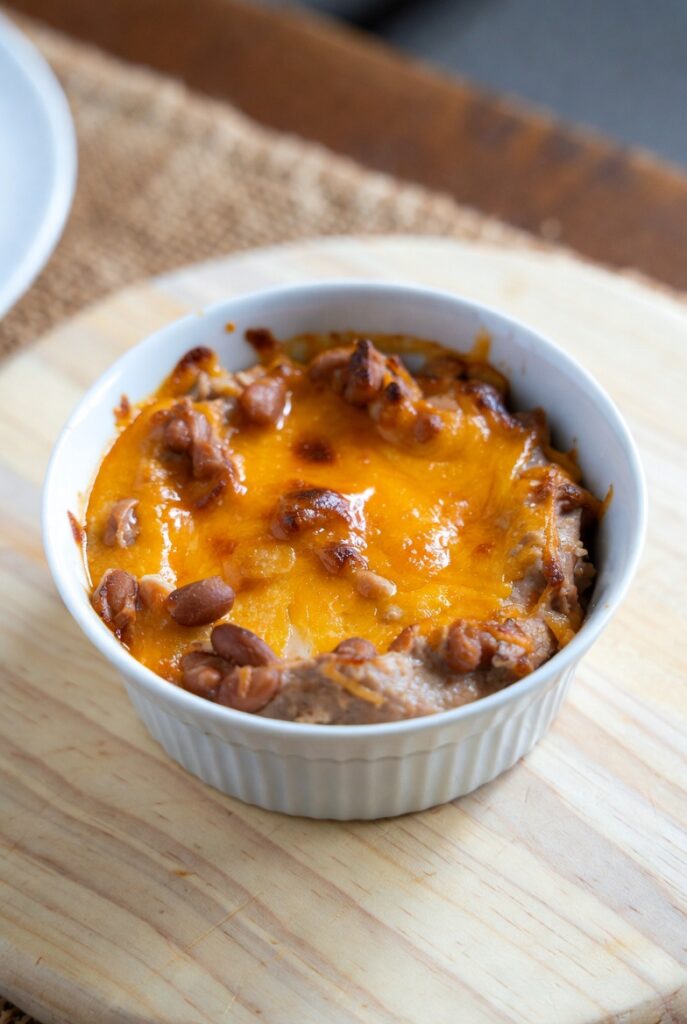
Roast for 20–25 minutes. You are looking for the cheese on top to be bubbling and for the edges to show a slight “Maillard Char.”
9. Modular Variations: Customizing the Intensity
The Cheesy Refried Bean Dip is a flexible “Flavor Template.” You can adapt it to match your specific dietary or flavor goals:
- The “Meat-Lovers” Shift: Add 1/2 lb of browned chorizo or ground beef to the mixture before baking for a “High-Protein” boost.
- The “Inferno” Standard: Add 2 tablespoons of chopped habaneros or extra hot salsa to the emulsion phase.
- The “Smokehouse” Pivot: Use smoked gouda instead of Monterey Jack and add a teaspoon of liquid smoke to mimic the flavor of a campfire bean pot.
- The “Lighter” Profile: Replace the sour cream with Greek yogurt for a “High-Protein/Lower-Fat” alternative.
10. Satiety and the “Protein-Fiber-Fat” Triad
The Cheesy Refried Bean Dip is a premier example of “Satiety Maximization.” In the world of nutritional science, the combination of Protein, Fiber, and Fat is the “Golden Triad” for feeling full.
- Fiber: The beans provide bulk that physically distends the stomach, signaling the brain that it is full.
- Protein: The cheese and beans trigger the release of cholecystokinin (CCK).
- Fat: The dairy slows down gastric emptying, ensuring the nutrients are absorbed slowly over time.
This makes the dip a “Self-Regulating” snack; unlike potato chips or pretzels, which can be eaten endlessly without satisfaction, a few scoops of bean dip provide a “Full-Stop” satiety signal to the brain.
11. Storage and Reheating: The Starch Recovery
Like all bean-based dishes, this dip will “tighten” as it cools due to the retrogradation of the starches.
- Refrigeration: Store in an airtight container for up to 5 days.
- The Reheat: To return the dip to its original “Silken Flow,” add 1 tablespoon of water or milk per cup of dip before reheating. This “loosens” the starch bonds.
- The “Burrito” Pivot: Leftover dip is an “Elite” filling for breakfast burritos or as a spread for tostadas.
12. Frequently Asked Questions (FAQ)
Q: Can I use black beans instead?
A: Yes. Refried black beans offer a slightly “earthier” flavor and a striking color contrast. The preparation method remains identical.
Q: Is this dip too heavy for summer?
A: While it is a “Warm Comfort” dish, it is often served at summer BBQs. To lighten it up for hot weather, serve it with fresh bell pepper strips and cucumber rounds instead of heavy corn chips.
Q: Why is my dip dry after baking?
A: This usually means the oven was too hot or the dish was left in too long. The beans continue to absorb moisture as they bake. If it looks dry, stir in a splash of salsa or warm water.
13. Nutritional Information
(Per serving – approx. 1/4 cup)
| Nutrient | Amount |
| Calories | 185 kcal |
| Protein | 10g |
| Total Fat | 12g |
| Net Carbs | 8g |
| Fiber | 5g |
| Molybdenum | High |